



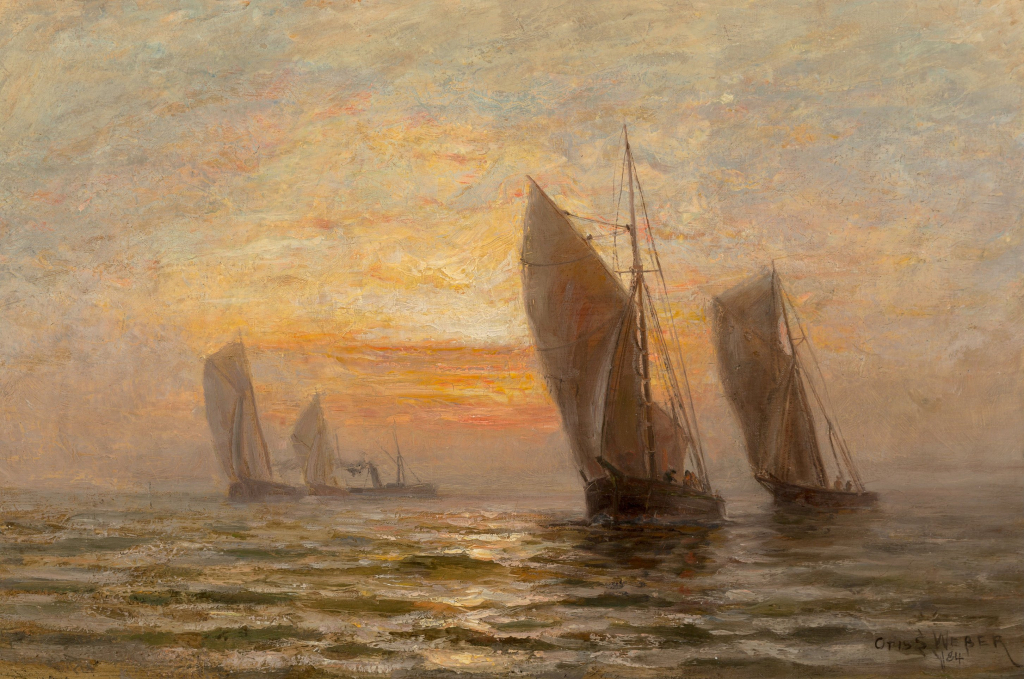
Sailing on at Sunset by Otis S. Weber, 1884
In this essay I do not attempt to show whether the Christian or Islamic visions of the end of the world are right. My aim is to show that the lack of the concept of renewal is not a gap within its philosophy. Rather, renewal does not make sense within the Islamic vision of the titanic events that take when hour arrives. Christianity’s vision is about the fulfillment of the Old Testament’s earth-centric promises. Islam’s vision is about the outer shell of the universe cracking and shattering so that the true reality shows through, and the successful ones are taken to the land of myth and fairytales in the best of our dreams, the reality beyond reality, the “happy ever after” that is not the anti-climactic marriage of a couple.
‘I thought that Elves were all for moon and stars: but this is more Elvish than anything I ever heard tell of. I feel as if I was inside a song, if you take my meaning.’ —Sam in The Fellowship of the Ring (the book version).
The concept of “renewal” as an important eschatological (“end of the world”) event has clear biblical roots that most Christian groups acknowledge—passages like Romans 8:19-23 (creation’s liberation from bondage), 2 Peter 3:13 (“new heavens and new earth”), Revelation 21:5 (“Behold, I make all things new”), and Isaiah (a book of the Old Testament unlike the previous New Testament ones) 65:17. These texts support some form of cosmic or creational renewal as part of God’s ultimate purposes.
See, I will create
new heavens and a new earth.
The former things will not be remembered,
nor will they come to mind. (Isaiah 65:17)
In The Brothers Karamazov (to me a mere a compilation of all that was expressed in his previous novels with more emotional force) the remade world is expressed as “eternal harmony” and the final justification of all suffering. Ivan quotes (and struggles with) the belief that in the world’s finale something will occur that will atone for “all the crimes of humanity” and make it possible not only to forgive but to justify all that has happened, which is an explicit hope for a consummated, transformed cosmos.
Tolkien expresses similar hopes. He argued that the “remade world” would not simply be a return to the original, uncorrupted state (Arda Unmarred). He believed in Arda Healed. In this version, the world is remade through a “Second Music” of the Ainur. This new world is greater and more beautiful than the original precisely because it has survived, suffered, and been redeemed. In Letter 89 and his essay On Fairy-Stories, he explains that the Resurrection of Christ is the “Eucatastrophe of Man’s history.” He believed this event was the literal beginning of the “world remade.” It provides a “fleeting glimpse of Joy, Joy beyond the walls of the world, poignant as grief.” To Tolkien, every good story that ends well is a small echo of the ultimate renewal of the entire universe. (It was this literarily beautiful idea of a “true myth” that convinced Lewis to take Christianity seriously and ultimately led to his conversion.)
Now, if we make the effort to treat Islam as seriously as Christianity, as an intellectually coherent framework, we can work out why it has no similar concept of renewal (and in discussions with Christians to try to argue that Islam, too, believes in “renewal” is to let the Christian framework of thought take over and put Islam into a Christian arena where it is sure to lose.)
Awakening
“Renewal” does not fit within Islam’s hopes and eschatology because the very word implies the existence of a valuable thing that deserves renewal. But there’s no such thing in Islam when it comes to this universe, at least not the part of it within our ken, i.e. our “world”. The Quran’s philosophy is to see this world as “fake goods” and “illusion”, as almost a dream that one needs to wake from, something half-real that distracts from the real thing. A dream does not cry out for renewal, but for awakening.
لَقَدْ كُنْتَ فِي غَفْلَةٍ مِنْ هَذَا فَكَشَفْنَا عَنْكَ غِطَاءَكَ فَبَصَرُكَ الْيَوْمَ حَدِيدٌ
You were in a state of heedlessness from this [true reality], but today your power of sight is flawless. (50:22)
يَقُولُ يَا لَيْتَنِي قَدَّمْتُ لِحَيَاتِي
He says, "I wish I had prepared provisions [i.e. good deeds] for my life [i.e. the "real life" after death]. (89:24)
قَالَ كَمْ لَبِثْتُمْ فِي الْأَرْضِ عَدَدَ سِنِينَ (112) قَالُوا لَبِثْنَا يَوْمًا أَوْ بَعْضَ يَوْمٍ فَاسْأَلِ الْعَادِّينَ (113) قَالَ إِنْ لَبِثْتُمْ إِلَّا قَلِيلًا لَوْ أَنَّكُمْ كُنْتُمْ تَعْلَمُونَ (114) أَفَحَسِبْتُمْ أَنَّمَا خَلَقْنَاكُمْ عَبَثًا وَأَنَّكُمْ إِلَيْنَا لَا تُرْجَعُونَ (115)
[God] says, "How many, of years counted, did you abide in the earth?" They say, "We abided a day or a few, so ask those who were counters." [God] says, "Indeed, you did not abide except very little, if you only knew. So did you suppose that We made you in pointless play, and that you were not going to return to Us?"
When God refers to Himself in the plural in the Quran, He is referring to Himself and His “establishment”, all those who directly and obediently serve under His authority; the heavenly military order obedient to His command and ready to His will, the military order that is archetype, the original creative artwork, that all such earthly orders hope to copy and only manage a flattery of it.
فَمَنْ زُحْزِحَ عَنِ النَّارِ وَأُدْخِلَ الْجَنَّةَ فَقَدْ فَازَ وَمَا الْحَيَاةُ الدُّنْيَا إِلَّا مَتَاعُ الْغُرُورِ
Therefore, whoever is slid away from the Fire, and is made to enter the Garden, has won success. And the life of the world is nothing but fake goods. (3:185)
وَمَا الْحَيَاةُ الدُّنْيَا إِلَّا لَعِبٌ وَلَهْوٌ وَلَلدَّارُ الْآَخِرَةُ خَيْرٌ لِلَّذِينَ يَتَّقُونَ أَفَلَا تَعْقِلُونَ
And the life of this world is naught but play and forgetful foolery, and the Home of the Hereafter is better for the God-fearing, so will you not use your power of rational thought? (6:32)
وَمَا الْحَيَاةُ الدُّنْيَا فِي الْآَخِرَةِ إِلَّا مَتَاعٌ
And the life of this world is nothing but a provision for the way [to the Hereafter].
وَمَا الْحَيَاةُ الدُّنْيَا إِلَّا مَتَاعُ الْغُرُورِ
And the life of this world is nothing but fake goods. (13:26 and 57:20)
Our Universe Thin As Paper
And among the Quranic eschatology is the “wrapping up” of the universe, showing its feeble nature in God’s Hands:
وَمَا قَدَرُوا اللَّهَ حَقَّ قَدْرِهِ وَالْأَرْضُ جَمِيعًا قَبْضَتُهُ يَوْمَ الْقِيَامَةِ وَالسَّماوَاتُ مَطْوِيَّاتٌ بِيَمِينِهِ سُبْحَانَهُ وَتَعَالَى عَمَّا يُشْرِكُونَ (67) وَنُفِخَ فِي الصُّورِ فَصَعِقَ مَنْ فِي السَّمَاوَاتِ وَمَنْ فِي الْأَرْضِ إِلَّا مَنْ شَاءَ اللَّهُ ثُمَّ نُفِخَ فِيهِ أُخْرَى فَإِذَا هُمْ قِيَامٌ يَنْظُرُونَ (68) وَأَشْرَقَتِ الْأَرْضُ بِنُورِ رَبِّهَا وَوُضِعَ الْكِتَابُ وَجِيءَ بِالنَّبِيِّينَ وَالشُّهَدَاءِ وَقُضِيَ بَيْنَهُمْ بِالْحَقِّ وَهُمْ لَا يُظْلَمُونَ (69)
They have not grasped the magnitude of Allah as He truly deserves—the entire earth will be nothing but a handful clenched in His fist on the Day of Resurrection, and the heavens will be crushed and folded up in His right hand! Glorified is He, supremely elevated above whatever they dare associate with Him! Then the Trumpet will blast, and every soul in the heavens and every soul on the earth will be struck down dead—save those Allah wills. Then it will blast a second time, and instantly they will be standing, staring in terror! And the earth will blaze with the light of its Lord, and the Book will be thrown open, and the prophets and witnesses will be brought forward, and judgment will be executed between them in absolute truth, and not one of them will escape injustice. (39:67-69)
كَلَّا إِذَا دُكَّتِ الْأَرْضُ دَكًّا دَكًّا (21) وَجَاءَ رَبُّكَ وَالْمَلَكُ صَفًّا صَفًّا (22) وَجِيءَ يَوْمَئِذٍ بِجَهَنَّمَ يَوْمَئِذٍ يَتَذَكَّرُ الْإِنْسَانُ وَأَنَّى لَهُ الذِّكْرَى (23) يَقُولُ يَا لَيْتَنِي قَدَّمْتُ لِحَيَاتِي (24)
No! When the earth is pounded to dust, crushed and pulverized again and again, and your Lord arrives with the angels in rank upon rank upon rank, and Hell is dragged forth on that Day—on that Day man will remember, but what good will remembering do him then? He will cry out: "If only I had sent forth something for my life!" (89:21-24)
فَارْتَقِبْ يَوْمَ تَأْتِي السَّمَاءُ بِدُخَانٍ مُبِينٍ (10) يَغْشَى النَّاسَ هَذَا عَذَابٌ أَلِيمٌ (11) رَبَّنَا اكْشِفْ عَنَّا الْعَذَابَ إِنَّا مُؤْمِنُونَ (12) أَنَّى لَهُمُ الذِّكْرَى وَقَدْ جَاءَهُمْ رَسُولٌ مُبِينٌ (13)
Then watch for the Day when the sky will bring forth visible smoke, enveloping mankind—this is a painful torment! "Our Lord, remove the torment from us! We are now believers!" But how can the reminder benefit them now, when a clear messenger had already come to them? (44:10-13)
These two verses do mention “earth”. But the “bringing forth” of Hell implies an effortless moving of realities, bringing them close, then setting them apart.
يَوْمَ تُبَدَّلُ الْأَرْضُ غَيْرَ الْأَرْضِ وَالسَّمَوَاتُ وَبَرَزُوا لِلَّهِ الْوَاحِدِ الْقَهَّارِ
On the Day when the earth will be replaced with another earth, and the heavens as well, and they will stand exposed before Allah, the One, the Overwhelming Conqueror. (14:48)
This verse, however, mentions a transformation not only of the earth, but of the heavens (the universe, which in Islam is usually envisions as layers within layers of “universes”) as well.
The key idea here is destruction and transformation, not renewal. Yet we do see clear echoes of C. S. Lewis’s destruction of Narnia and its renewal. But its location, and its nature, remain unclear and undecided.
The Outer Reality Showing Through A Shredded Sky
In fact, to us Muslims, it’s a mere matter of coordinates. It matters little where in the Divine creation the Paradise or the earth that was crushed and remade will be located. In the Milky Way, or the New Eden galactic sphere, or the universe that will be opened to us once the “heaven” of this world is torn open for God and His armies to pour through:
فَإِذَا انْشَقَّتِ السَّمَاءُ فَكَانَتْ وَرْدَةً كَالدِّهَانِ
Then when the sky is ripped apart and becomes rose-red like molten oil. (55:37)
فَإِذَا نُفِخَ فِي الصُّورِ نَفْخَةٌ وَاحِدَةٌ (13) وَحُمِلَتِ الْأَرْضُ وَالْجِبَالُ فَدُكَّتَا دَكَّةً وَاحِدَةً (14) فَيَوْمَئِذٍ وَقَعَتِ الْوَاقِعَةُ (15) وَانْشَقَّتِ السَّمَاءُ فَهِيَ يَوْمَئِذٍ وَاهِيَةٌ (16) وَالْمَلَكُ عَلَى أَرْجَائِهَا وَيَحْمِلُ عَرْشَ رَبِّكَ فَوْقَهُمْ يَوْمَئِذٍ ثَمَانِيَةٌ (17) يَوْمَئِذٍ تُعْرَضُونَ لَا تَخْفَى مِنْكُمْ خَافِيَةٌ (18)
Then when the Trumpet is blown with a single blast, and the earth and the mountains are lifted up and crushed with a single crushing blow—on that Day the inevitable Event will strike! And the sky will split apart, for on that Day it will be frail and crumbling. And the angels will be at its edges, and eight will bear the Throne of your Lord above them on that Day. On that Day you will be exposed—not a single secret of yours will remain hidden. (69:13-18)
إِذَا السَّمَاءُ انْشَقَّتْ (1) وَأَذِنَتْ لِرَبِّهَا وَحُقَّتْ (2) وَإِذَا الْأَرْضُ مُدَّتْ (3) وَأَلْقَتْ مَا فِيهَا وَتَخَلَّتْ (4) وَأَذِنَتْ لِرَبِّهَا وَحُقَّتْ (5) يَا أَيُّهَا الْإِنْسَانُ إِنَّكَ كَادِحٌ إِلَى رَبِّكَ كَدْحًا فَمُلَاقِيهِ (6)
When the sky is split apart and submits to its Lord as it must, and when the earth is stretched out flat and casts out everything inside it and becomes empty, and submits to its Lord as it must—O mankind! You are laboring towards your Lord with great struggle, and you will meet Him! (84:1-6)
وَيَوْمَ تَشَقَّقُ السَّمَاءُ بِالْغَمَامِ وَنُزِّلَ الْمَلَائِكَةُ تَنْزِيلًا (25) الْمُلْكُ يَوْمَئِذٍ الْحَقُّ لِلرَّحْمَنِ وَكَانَ يَوْمًا عَلَى الْكَافِرِينَ عَسِيرًا (26)
And on the Day when the sky will split open with clouds and the angels will be sent down in a mighty descent—true sovereignty on that Day will belong to the Most Merciful, and it will be a Day of crushing hardship for the disbelievers. (25:25-26)
And this tearing apart of the borders of this universe involves a theme of leaving:
إِنَّ الَّذِينَ كَذَّبُوا بِآَيَاتِنَا وَاسْتَكْبَرُوا عَنْهَا لَا تُفَتَّحُ لَهُمْ أَبْوَابُ السَّمَاءِ وَلَا يَدْخُلُونَ الْجَنَّةَ حَتَّى يَلِجَ الْجَمَلُ فِي سَمِّ الْخِيَاطِ وَكَذَلِكَ نَجْزِي الْمُجْرِمِينَ
Indeed, those who denied Our signs and were too arrogant to accept them—the gates of heaven will not be opened for them, nor will they enter Paradise until a camel passes through the eye of a needle. And thus do We repay the criminals. (7:40)
Yet again we meet the theme of the wrapping up of the universe like a sheet of paper combined with a mention of the earth, or some earth:
يَوْمَ نَطْوِي السَّمَاءَ كَطَيِّ السِّجِلِّ لِلْكُتُبِ كَمَا بَدَأْنَا أَوَّلَ خَلْقٍ نُعِيدُهُ وَعْدًا عَلَيْنَا إِنَّا كُنَّا فَاعِلِينَ (104) وَلَقَدْ كَتَبْنَا فِي الزَّبُورِ مِنْ بَعْدِ الذِّكْرِ أَنَّ الْأَرْضَ يَرِثُهَا عِبَادِيَ الصَّالِحُونَ (105)
On the Day when We will roll up the sky like a scroll is rolled up for writings—just as We began the first creation, We will restore it. This is a binding promise upon Us. Indeed, We are certain to do it. And We have already written in the Psalms after the Reminder that My righteous servants will inherit the earth. (21:104-105)
The Clearest Verse on Paradise Not Being Earth, Or Is It a Confusion of Different Stories?
سَابِقُوا إِلَى مَغْفِرَةٍ مِنْ رَبِّكُمْ وَجَنَّةٍ عَرْضُهَا كَعَرْضِ السَّمَاءِ وَالْأَرْضِ أُعِدَّتْ لِلَّذِينَ آَمَنُوا بِاللَّهِ وَرُسُلِهِ ذَلِكَ فَضْلُ اللَّهِ يُؤْتِيهِ مَنْ يَشَاءُ وَاللَّهُ ذُو الْفَضْلِ الْعَظِيمِ
Race toward forgiveness from your Lord and a Paradise as vast as the heavens and the earth, prepared for those who believed in Allah and His messengers. That is the bounty of Allah—He grants it to whomever He wills, and Allah is the Possessor of tremendous bounty. (57:21)
While all this may seem like a confusion of different stories and different takes on eschatology, what is very difficult to appreciate is that the Quran is “music”, a symphony. It never gives the full story away about any matter whatsoever; you have to wait for it to come back to the story, or the idea, or the theme to add a new brushstroke to it, often with mysterious hints of yet unfilled details, pulling the reader in to keep reading.
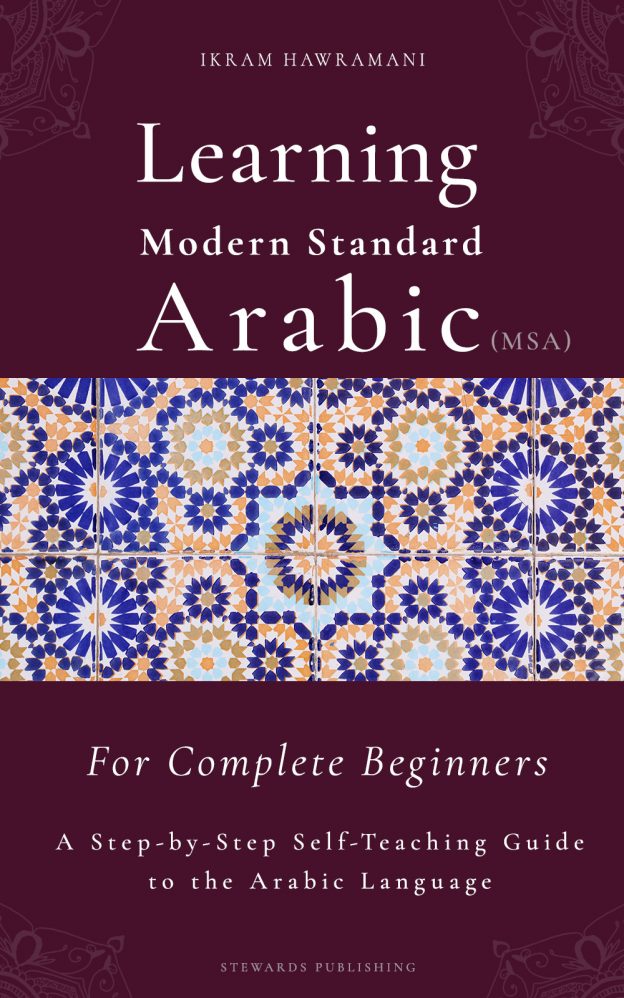
In my very highly-rated Learning Quranic Arabic for Complete Beginners (Amazon link) I rejected all familiar learning methods to use something very similar, inspired by what I knew about the way I learn best, and the ineffectiveness of typical educational books on language. This method is analogical to environmental storytelling (as in Wuthering Heights), and can be called contextual revelation. The scientific reason it works might be that there’s only so much stamina in the brain to expand the neuronal network it dedicates to a particular topic (such as the story of Moses, peace be upon him) in order to integrate large amounts of details all in one go. Rather, what might be best is to give a small number of new details, then move on to another topic, stored in a different neural network, and provide some details on that, while always including some repetition and reinforcement of previous details.
The Quranic eschatology contains no contradiction: Planet Earth will be turned into a featureless and dusty planet. Paradise will become accessible through leaving the “gates” of the present “heaven” (perhaps universe, but it might also refer to the solar system). There are multiple ways to envision what might actually take place, such as a “shell” being removed around the universe, or an alternate reality a breath away becoming open so that our universe remains, but “with the curtains drawn”. If we do not assume that the Quran is contradictory, we can find solutions. But those who wish to find falsehoods in the Quran will refuse to give the pictures time to come to life. This has a good scientific explanation; when we read or hear things we disagree with, blood flow to the prefrontal cortex is reduced, and this is exactly the part of the brain required for entertaining new ideas and visualizing complex concepts.
The Quran is not written for intellectuals. It is written for the human psyche of almost any level capable of imagination. It rapid-fires image after image after image (except in the legal verses), switching topics, coming back to them, breaking Arabic grammar and conventions of speech, and relentlessly attacking the reader’s psyche to break down the walls of their self-regard and arrogance–very often hidden self-regard and arrogance we’re not aware of. The Quran shows you that whatever clever ideas you have about the world and yourself, whatever world of meaning you have created to give yourself a comfortable place according to your own rules, you are building a house of cards. You cannot escape its sight. And this is what even a non-Muslim Islamic studies scholar admits:
Fredrick Denny, a non-Muslim writer, recalls the “wonderfully disturbing experience” one sometimes has when reading the Qur’an, when the reader starts feeling “an uncanny, sometimes frightening presence.” Instead of reading the Qur’an, the reader begins feeling the Qur’an is “reading” the reader!
The gaze of the Quran on the reader’s psyche is unbearable when he or she wants to hold onto their own carved-out space of existence apart from God. There’s nowhere to hide, and He is the only refuge from the terror of His gaze.
Until the earth, vast as it was, closed in upon them, and their very souls closed in upon them, and they realized that there is no refuge from Allah except in Him—then He turned to them in mercy so that they might repent. (9:118)
No Renewal, But Destruction, Angels Descending Through Tears in the Sky, Wrapping Up the Universe, Awakening, and the Reordering of Existence.
In our imagination God and His angels may seem distant, the borders of the universe safely far away, so that we may imagine we will have early warning of any truly disastrous change tearing our universe apart. But the Quran says:
وَنَحْنُ أَقْرَبُ إِلَيْهِ مِنْ حَبْلِ الْوَرِيدِ
And We [God and His heavenly order] are closer to [the human] than his jugular vein. (50:16)
وَلَوْ تَرَى إِذْ فَزِعُوا فَلَا فَوْتَ وَأُخِذُوا مِنْ مَكَانٍ قَرِيبٍ
And if only you could see when they are struck with terror—but there will be no escape, and they will be seized from a place nearby. (34:51)
وَاسْتَمِعْ يَوْمَ يُنَادِ الْمُنَادِ مِنْ مَكَانٍ قَرِيبٍ (41) يَوْمَ يَسْمَعُونَ الصَّيْحَةَ بِالْحَقِّ ذَلِكَ يَوْمُ الْخُرُوجِ (42)
And listen for the Day when the caller will call out from a place nearby—the Day when they will hear the blast in truth. That is the Day of emergence from the graves. (50:41-42)
The image the Quran gives us is that the eschatological event does not involve the traversal of space, but a reality that encompasses ours showing through tears in the sky. Space was just an illusion, a limit on ours powers.
From Earth-Centrism to God-Centrism
Christianity takes the earth too seriously, which seems a clear inheritance from the Old Testament’s strong focus on the worldly fate of the Jewish people. Eschatology centers around earth and its fate. The Quran’s focus, however, is on God; eschatology revolves around Him; He destroys much of reality and remakes it in a new way. This is not renewal, but a case analogical to to turning an artwork to dust and reordering it. And of course, as placed above, the Quran does include the clear statement of the “turning to dust” of the earth, and as stated below, the way the earth will be made into a round ball with no topographical features, just a dusty flat plane, with the light of God illuminating it, and Hell brought near, and the gates of Heaven of opening up to the successful.
يَوْمَ يُنْفَخُ فِي الصُّورِ وَنَحْشُرُ الْمُجْرِمِينَ يَوْمَئِذٍ زُرْقًا (102) يَتَخَافَتُونَ بَيْنَهُمْ إِنْ لَبِثْتُمْ إِلَّا عَشْرًا (103) نَحْنُ أَعْلَمُ بِمَا يَقُولُونَ إِذْ يَقُولُ أَمْثَلُهُمْ طَرِيقَةً إِنْ لَبِثْتُمْ إِلَّا يَوْمًا (104) وَيَسْأَلُونَكَ عَنِ الْجِبَالِ فَقُلْ يَنْسِفُهَا رَبِّي نَسْفًا (105) فَيَذَرُهَا قَاعًا صَفْصَفًا (106) لَا تَرَى فِيهَا عِوَجًا وَلَا أَمْتًا (107) يَوْمَئِذٍ يَتَّبِعُونَ الدَّاعِيَ لَا عِوَجَ لَهُ وَخَشَعَتِ الْأَصْوَاتُ لِلرَّحْمَنِ فَلَا تَسْمَعُ إِلَّا هَمْسًا (108) يَوْمَئِذٍ لَا تَنْفَعُ الشَّفَاعَةُ إِلَّا مَنْ أَذِنَ لَهُ الرَّحْمَنُ وَرَضِيَ لَهُ قَوْلًا (109) يَعْلَمُ مَا بَيْنَ أَيْدِيهِمْ وَمَا خَلْفَهُمْ وَلَا يُحِيطُونَ بِهِ عِلْمًا (110) وَعَنَتِ الْوُجُوهُ لِلْحَيِّ الْقَيُّومِ وَقَدْ خَابَ مَنْ حَمَلَ ظُلْمًا (111)
On the Day when the Trumpet is blown and We will gather the criminals on that Day blue-eyed with terror, whispering among themselves: "You stayed only ten days." We know full well what they will say—when the most perceptive among them will say: "You stayed only a single day." And they ask you about the mountains—say: "My Lord will blast them into scattered dust, leaving the earth a barren, level plain where you will see neither curve nor elevation." On that Day they will follow the caller with no deviation from him, and all voices will fall silent before the Most Merciful, so you will hear nothing but a faint murmur. On that Day, no intercession will benefit anyone except the one whom the Most Merciful permits and whose word He approves. He knows what is before them and what is behind them, but they cannot encompass Him in knowledge. And all faces will be humbled before the Ever-Living, the Sustainer, and whoever bore injustice will have utterly failed. (Quran 20:102-111)
While the Christian imagery of renewal has its own beautiful aesthetics and deeply meaningful corollaries, the music of the Quran tells a different story.
And I like the Quranic story better; I’m both what might be called a poetic, literary and artistic type, and a data-and-logic-centered realistic. I have little in common with programmers who can’t design and appreciate literature, or artistic types with wishy-washy inspiring ideas without philosophical foundation. But what I need most is not the aesthetic, Christian end, but the hard, Quranic ending of the story.
I cannot relate logically to the Christian vision (of course each person has the right to relate to what they relate to); the world renewed feels like being stuck in the same provincial backwater as before; I want to see the actual reality behind the sky, the well at the world’s end, the magic fairy land you can step into that heals all your woes and makes this disaster of a world feel like a bad a dream, the world of myth become reality.
‘I am old, Gandalf. I don’t look it, but I am beginning to feel it in my heart of hearts. Well-preserved indeed!’ he snorted. ‘Why, I feel all thin, sort of stretched, if you know what I mean: like butter that has been scraped over too much bread. That can’t be right. I need a change, or something.’
Gandalf looked curiously and closely at him. ‘No, it does not seem right,’ he said thoughtfully. ‘No, after all I believe your plan is probably the best.’
‘Well, I’ve made up my mind, anyway. I want to see mountains again, Gandalf – mountains; and then find somewhere where I can rest. In peace and quiet, without a lot of relatives prying around, and a string of confounded visitors hanging on the bell. I might find somewhere where I can finish my book. I have thought of a nice ending for it: and he lived happily ever after to the end of his days.’
Gandalf laughed. ‘I hope he will. But nobody will read the book, however it ends.’
***
Of course religion is not a pick-your-favorite-mythology matter. I have other reasons for believing in God. Speaking purely as a software engineer and analytical thinker who gives no quarter to the slightest vagueness in philosophical argument, I believe the Kalam Cosmological Argument makes God’s existence unescapable, this is the serial or syllogistic part of my belief. As for my belief in the Quran, it is a case of multi-variate analysis; it happens to be the best book out there that affirms the God proven by the Kalam Cosmological Argument, and the God I have known in my heart all my life.
Conclusion
Islam has no concept of renewal because it has no place within its end-of-the-world vision of the universe being made into chaos then a new order being enforced on it. Islam’s “earth” is “as wide as the heavens and the earth”. We do not look forward to a New Jerusalem, but to a new reality.
In the end, it might be said that whatever I said about the positives of the Islamic “happy ending” may apply equally to Christianity’s. But it wasn’t the aim of my essay to prove that Islam’s vision is superior (although it is to me). The aim of my essay was to show that Islam’s like of a concept of renewal is not a gap/lacuna within its eschatological framework. It has no place for it because it offers an alternative; the universe opening up, the true reality becoming manifest, and a Paradise as wide as the universe becoming an eternal home for the Prophets and the saints and those who follow in their footsteps.
***
Then Frodo kissed Merry and Pippin, and last of all Sam, and went aboard; and the sails were drawn up, and the wind blew, and slowly the ship slipped away down the long grey firth; and the light of the glass of Galadriel that Frodo bore glimmered and was lost. And the ship went out into the High Sea and passed on into the West, until at last on a night of rain Frodo smelled a sweet fragrance on the air and heard the sound of singing that came over the water. And then it seemed to him that as in his dream in the house of Bombadil, the grey rain-curtain turned all to silver glass and was rolled back, and he beheld white shores and beyond them a far green country under a swift sunrise.